
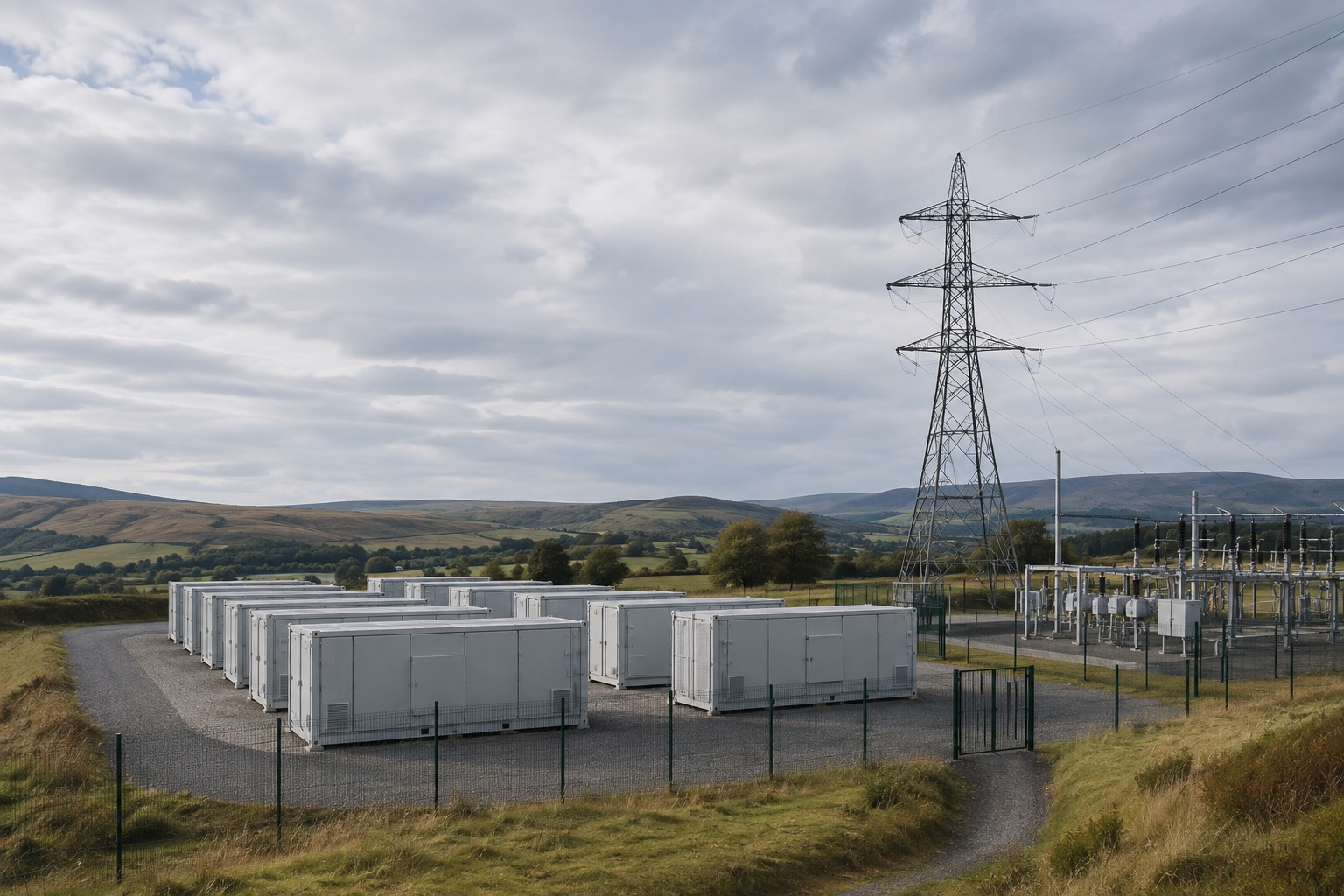
A place in the reformed queue is a development milestone, not a complete project assessment. Britain’s battery storage reforms provide a useful case study for project owners and teams reviewing a potential acquisition: what is evidenced, what remains conditional, and what still separates a connection offer from ready-to-build.
Britain’s pre-reform connections queue exceeded 700 GW. In December 2025, the National Energy System Operator (NESO) announced a prioritised pipeline of 283 GW of generation and storage, alongside 99 GW of transmission-connected demand. Those are pipeline capacities, not completed projects.[1]
The 25 August update from National Grid Electricity Transmission (NGET) reports 298 offers issued to NESO, around 92% of Phase 1, as at 4 August. This measures offers passed to NESO, not offers received or accepted by customers.[2]
The reform package is Target Model Option 4 Plus (TMO4+). It includes code modifications CMP434 and CMP435; the reassessment of existing projects is Gate 2 to Whole Queue (G2tWQ).[3, 4] This article covers Great Britain — England, Scotland and Wales — not Northern Ireland.
CurvatureEnergy is a Swiss BESS developer. We follow Britain’s reforms because they make a recurring development question especially clear: what does a project’s stated status actually prove? The useful lesson for our work in Switzerland is the review discipline, not an assumption that British rules apply elsewhere.
The previous approach largely followed application order. A long-held queue position could sit ahead of a more advanced project.
Progression to Gate 2 depends on evidence of readiness and strategic alignment, not simply how early a project applied.
Treat Gate 2 as a connection-development milestone, not as a ready-to-build certificate. An offer is the starting point for checking the revised scope, dates and obligations.
NESO’s customer guidance says Gate 2 projects meet both readiness and strategic-alignment requirements and can secure a confirmed connection date, connection point and queue position. Gate 1 does not provide a confirmed connection date; future progression depends on the applicable criteria and application windows.[4]
Readiness is not synonymous with full planning consent. NESO expects most projects to use the land-rights route; it also describes a specific alternative involving submission and validation of a Development Consent Order application. Neither should be read as a blanket confirmation that every consent and construction condition has been satisfied.[6]
For a project owner or acquisition team, a ‘Gate 2 secured’ label is therefore the start of the review. Ask which document supports the label, whether the offer has been accepted, and which conditions still stand between the project and construction.
| Status | What it establishes | What still needs checking |
|---|---|---|
| Gate 1 | No confirmed connection date under the reformed process. | Whether and how the project could qualify for Gate 2 in a future window. |
| Gate 2 | Readiness and strategic alignment for progression to a confirmed connection offer. | The actual offer, its acceptance status, technical scope, dates and obligations. |
| Ready-to-build | A separate development assessment, not a Gate 2 classification. | Land and access rights, planning conditions, connection deliverability and an executable construction package. |
Gate definitions: NESO.[4] The ready-to-build row is CurvatureEnergy’s development-assessment framework, not an additional regulatory gate.
NESO separates transmission and large distribution-connected (‘large embedded’) offers from other distribution offers. As checked on 4 September 2026, its schedule runs Phase 1 transmission offers to mid-September, with Phase 2 scheduled from early September. These are offer-issuance windows, not new application windows or energisation dates; a scheduled opening does not confirm delivery of an individual offer.[7]
| Offer group | Phase 1 | Phase 2 |
|---|---|---|
| Transmission and large embedded | Mid-May–mid-September 2026 | Early September 2026–mid-January 2027 |
| Distribution | Early July–mid-November 2026 | Mid-October 2026–mid-March 2027 |
These are the general Phase 1 and Phase 2 windows; protected-project offers have separate timings. Customers of a distribution network operator (DNO) should ask that operator for project-specific guidance.[7]
Dates need particular care. In February 2026, Ofgem acknowledged that some projects with protected connection dates would no longer meet their original dates. Protection and eligibility should therefore be checked against the current offer and delivery position, not treated as unconditional guarantees.[8]
NESO’s published summary says there is no permitted capacity for batteries to enter the pipeline in the next application window unless one of three conditions applies: the project qualifies under protection clause 2b or 3a; more than 55 GW of Gate 2 battery projects leave the pipeline; or future strategic energy plans increase permitted battery capacity by more than 55 GW. This is the published planning allowance, not a statement that every substation is physically full. Confirm the applicable methodology before relying on an exception.[5]
NESO’s June 2026 consultation records 83.2 GW of batteries with Gate 2 status, or 90.6 GW including operational capacity at the evidence-window close. The combined figure exceeds three times the 24–29 GW range for 2035 in the Clean Power 2030 (CP30) Action Plan.[9]
The DESNZ/Ofgem letter dated 17 April reports 14.8 GW above the top of the 2030 battery range and 61.7 GW above projected 2035 need. It nevertheless supports a market environment enabling 23–27 GW by 2030.[10]
These are dated snapshots with their stated scope, not a live count of projects that will be built. For a new site, establish the route into the connections process before detailed design. For an existing Gate 2 project, test the offer and site together: neither a national capacity figure nor a nearby substation establishes a workable connection.
These six checks set out CurvatureEnergy’s development-review approach, illustrated here through UK Gate 2. The same questions guide assessment of a Swiss greenfield site, with different local rules and evidence requirements. The purpose is to distinguish documented facts, unresolved conditions and the party responsible for each next step — not to add NESO eligibility rules.
Obtain the latest offer and agreement. Check the applicant, connection point, status, acceptance deadline and any superseded documents.
Check charging and discharging capacity separately, in MW. Identify restrictions, staged access and dependencies on reinforcement works.
Match the battery layout to the secured land. Check access, cable rights, third-party land and the duration of relevant agreements.
Review the applicable consent route, outstanding conditions, fire-safety approach, noise, drainage and access. Do not infer consent from queue status.
Identify who must deliver each connection and reinforcement work, what it depends on, and how that affects the proposed energisation date.
Reconcile current charges, securities, milestone dates and termination provisions with the project programme. Record assumptions that still need confirmation.
For an owner or acquisition team, the useful output is a reconciled view of the connection offer, land rights, permitting and construction dependencies — with an owner and next action for each unresolved point. A pipeline summary should describe those development stages consistently, rather than treating every headline MW as equally advanced.
This is the same distinction explored in our ready-to-build versus greenfield BESS analysis: project maturity comes from resolving dependencies. Our developers and partners page explains CurvatureEnergy’s approach to project review and development collaboration.
For the market in which CurvatureEnergy is based, our analysis of BESS development in Switzerland explains the local development context. The British case is a comparison of assessment questions, not a forecast that Switzerland will adopt Gate 2.
Sources checked on 4 September 2026. Links lead to the grid operators’ and regulator’s own publications. Short original-language excerpts are shown below; the checklist and development implications are CurvatureEnergy’s analysis.
customers receive Phase 1 offers
readiness and Strategic Alignment
there is no permitted capacity
Header image: AI-generated illustration, not a photograph of an existing project or evidence of an approved connection.