
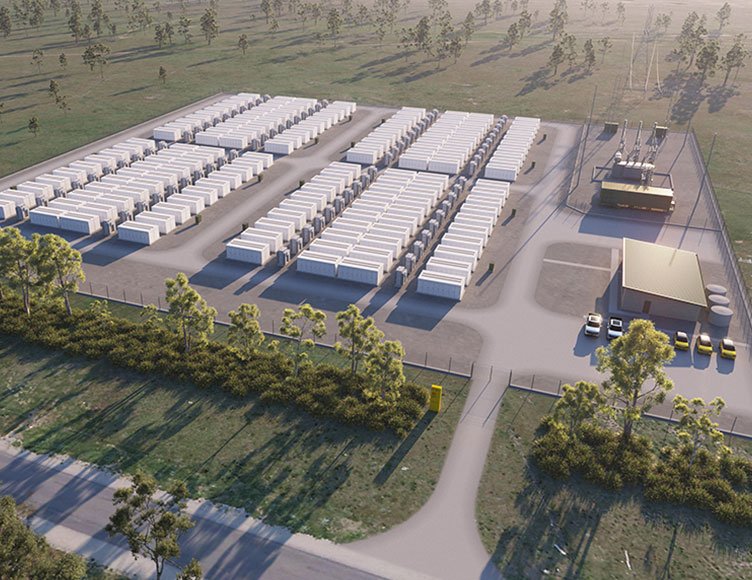
Battery technology is not what decides whether a Swiss BESS project happens. Grid position and permitting are. Here is what actually gates a project, why the answer differs from one municipality to the next, and what a site needs to show before it is worth taking further.
Lithium-iron-phosphate systems are a mature, commoditised product with a competitive supply chain. Specifying one is a procurement exercise. What determines whether a Swiss BESS project reaches construction is something far less portable: whether a specific parcel, in a specific municipality, connected to a specific distribution operator, can obtain grid capacity and a building permit.
Switzerland makes that harder than most European markets for a structural reason. The country has roughly 600 distribution grid operators, and network access conditions rest substantially on cantonal and communal law rather than a single federal standard. There is no national queue, no uniform connection procedure, and no single counterparty. A project that is straightforward in one canton can be unviable across the boundary — not because the engineering differs, but because the grid position and the permitting authority do.
Site screening in Switzerland is therefore not a search for good land. It is a search for a viable grid position that happens to have land attached to it.
A 2025 survey of Swiss distribution grid operators — covering operators representing some 8,600 MW of coincident network load — found connection demand from large batteries already exceeding what existing networks can absorb. The pattern it describes is the single most useful thing a developer or landowner can understand before spending money on a site.
| What the survey found | Observation | Why it matters to a project |
|---|---|---|
| Queue congestion | 7 of 9 operators had pending connection requests exceeding 10% of their network load | Realisation without network expansion is described as not realistically possible at that volume |
| Waiting lists | A quarter of operators maintain them | Grid capacity is allocated over time, not on demand |
| Constrained agreements | Half apply individual connection agreements with limited feed-in or withdrawal capacity | A connection may be granted but capped — the technical envelope is a negotiated outcome |
| Voltage-level assignment | Batteries above roughly 4–5 MW belong at grid level 3 or higher | Larger systems should not consume capacity reserved for ordinary load growth at lower levels |
| Speculative applications | First-come-first-served filing blocks capacity | Serious projects compete with placeholder applications for the same headroom |
Source: EVU Partners AG — survey of Swiss distribution grid operators on large battery storage connection. Figures are as reported by the surveyed operators and describe the sample, not a national census. Transmission-level connections follow a separate procedure with Swissgrid.
Two practical consequences follow. First, the question "can this site be connected?" has no general answer — it has an operator-specific answer, and obtaining it early is the cheapest risk reduction available in the whole development process. Second, the size of the system is not a free choice. Crossing the roughly 4–5 MW threshold changes which voltage level the project belongs at, which changes the counterparty, the technical requirements and the timeline. Sizing is a grid decision before it is a commercial one.
A grid-scale BESS installation requires a building permit, and Swiss building permits are cantonal and communal instruments. The procedure, the documentation, the objection window and the treatment of the installation under the local zone plan all vary. There is no federal fast track for storage equivalent to the simplified notification procedures that exist for some solar installations.
In practice the decisive question is usually zoning rather than the permit itself. A containerised battery compound on land already zoned for industrial or commercial use is a comparatively ordinary application. The same compound on agricultural land outside the building zone is a different proposition entirely, because Swiss spatial planning law treats construction outside the building zone restrictively and the exemption route is neither quick nor certain.
This is why site screening should test zoning before anything else. A parcel with excellent grid proximity but the wrong zoning designation is not a project with a permitting problem to be solved later — it is usually not a project.
The purpose of a first BESS site screening is not to prove a project works. It is to rule sites out cheaply, before anyone commissions a study. Six things carry most of the decision.
Distance to a substation or suitable medium- and high-voltage infrastructure, and which distribution operator controls it. Proximity is the single most decisive factor.
Whether the parcel sits inside a building zone and whether the designation accommodates a technical installation of this kind.
Whether the operator has capacity at that node, or whether the site enters a waiting list or a capped connection agreement.
Sufficient area for a containerised system, plus safe permanent access for installation, maintenance and emergency services.
Proximity to residential use, protected areas, groundwater zones or other constraints that turn a routine permit into a contested one.
Whether the owner is willing to enter a long-term arrangement, and whether the person negotiating actually holds the authority to do so.
Switzerland is adjusting the rules around storage rather than leaving them fixed. One example: from 1 January 2026, the grid-usage component levied on electricity that is drawn from the network, stored and later returned is refundable under defined conditions — a change aimed at the long-standing problem of storage being charged twice for the same electron. As implemented and communicated by distribution operators, that mechanism addresses home storage and bidirectionally charging vehicles; the treatment of grid-scale installations remains a matter to confirm with the relevant operator rather than to assume.
The demand side is moving faster than the framework. Swissolar's Batteriemonitor puts storage on a steep growth path in the Swiss energy system, and behind-the-meter installation volumes have been rising sharply. Grid-scale projects are being announced by established Swiss utilities. The constraint is not appetite; it is the rate at which network capacity and permitting practice can absorb it.
For anyone assessing a site today, the sensible posture is to treat the regulatory position as a variable to be verified per project and per operator, not as a settled national parameter. That verification is unglamorous work, and it is where most of the risk actually sits.
Sources: CKW — grid-usage reimbursement for electricity returned from storage · Swissolar — Batteriemonitor Schweiz 2026 · ESS News — Swiss storage installation volumes · Axpo / energieUri (in German). Regulatory descriptions summarise publicly available provider and association material and are not legal advice; applicability to any specific project should be confirmed with the responsible grid operator and authority.
The same constraint reads differently depending on where you sit in a project.
The question is not what the land is worth in general, but whether this parcel holds a viable grid position and a workable zoning designation. Both are checkable before any commitment is made. Land for battery storage
An existing connection is an asset. The question is how much headroom it carries, and whether storage can be integrated behind the meter without triggering a connection upgrade. Industrial sites
With capacity contested and conditions operator-specific, what separates a working battery storage developer from a hopeful one is disciplined screening — ruling sites out early and cheaply so effort concentrates where a path exists. Developers & partners