
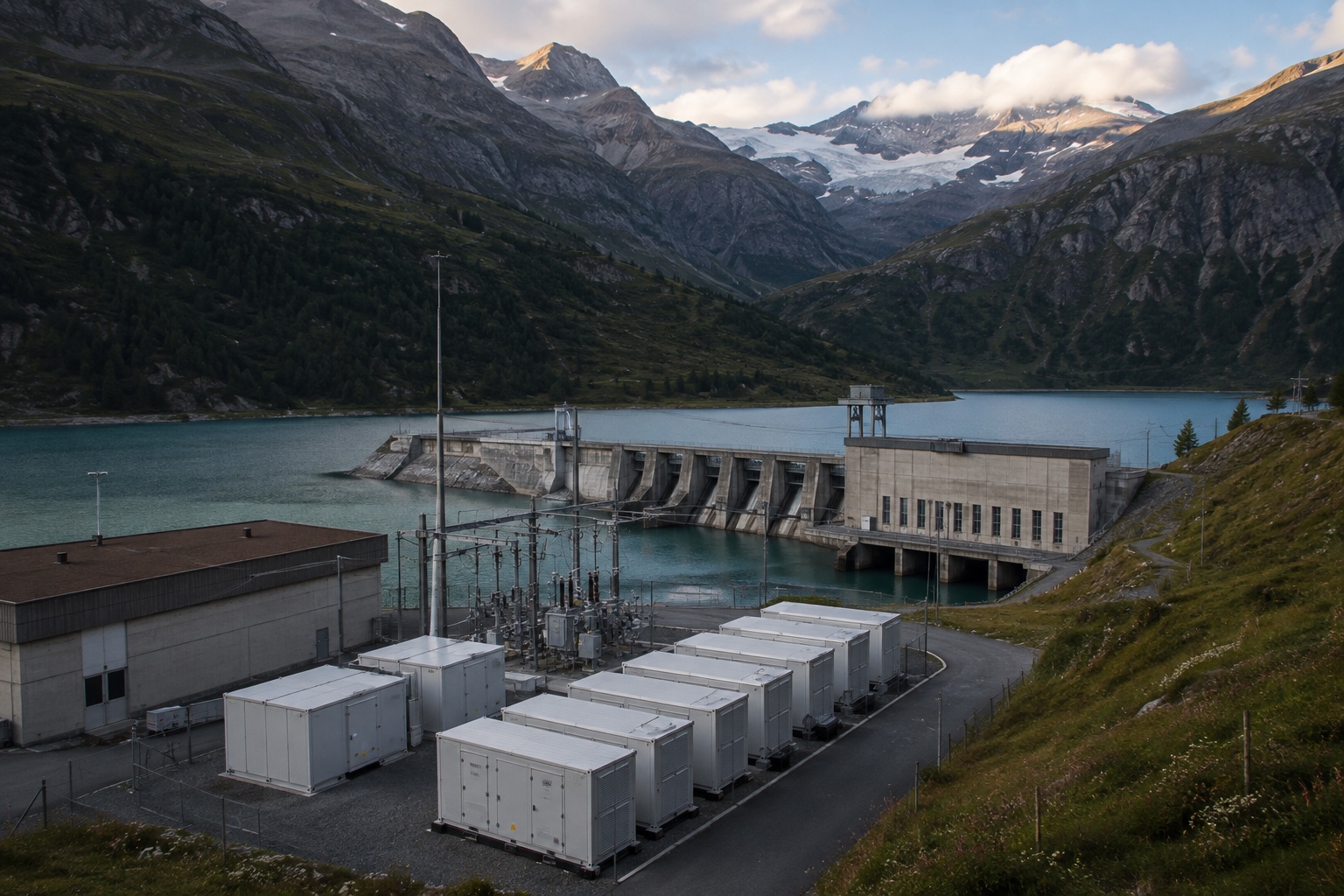
Hydropower supplies most Swiss electricity and already moves energy across hours, days and seasons. That does not make batteries redundant. It makes the comparison more exacting: a BESS has to solve a timing, location or control problem that water storage does not solve as efficiently at that point in the grid.
The Swiss Federal Office of Energy reports that hydropower provides 58.5% of national electricity production on a ten-year average. Its statistics distinguish 8,124 MW of storage hydropower and 3,503 MW of pumped storage, in addition to run-of-river plants. The same federal page describes storage plants as important both for power at short notice and for shifting production from summer to winter.[1]
Nant de Drance shows the scale already available in one asset: 900 MW of power, 20 million kWh of storage and a five-minute transition from full pumping to full generation. Dividing its stated energy by power gives roughly 22 hours at nameplate output — a different duration class from most current lithium-ion projects.[2]
The useful question is therefore not whether BESS is faster than “hydro” in the abstract. Swiss storage hydro already supplies control energy and can respond rapidly. The question is whether a battery's response speed, cycling profile and position in the network create a distinct operational role.[3]
In Switzerland, a battery does not need to replace hydropower to be useful. It needs to complement a system in which water already provides both flexibility and substantial energy duration.
| Resource | Best suited to | Development question |
|---|---|---|
| Reservoir hydropower | Holding large volumes of energy and scheduling water across extended periods, including seasonal transfer. | What water, concession, environmental and transmission constraints govern dispatch? |
| Pumped storage | Bulk storage with high power and multi-hour duration. Nant de Drance can change from full pumping to full generation in five minutes.[2] | Is the need large and persistent enough to justify major civil works and two-reservoir geography? |
| Short-duration BESS | Fast, repeatable active-power response, local congestion management, voltage support and control-energy participation where connection and prequalification permit it. Swissgrid’s roadmap set mid-2026 as the date for lowering the minimum bid size for tertiary products from 5 MW to 1 MW; secondary products are scheduled for mid-2027.[4, 10] | Which service exists at this grid node, and how much energy must be reserved to deliver it? |
| Long-duration storage | Supplying power for many consecutive hours when the requirement is energy duration rather than only fast response. | What duration is actually required? Ofgem uses at least eight hours for one British scheme; the US Department of Energy defines LDES as ten hours or more.[8, 9] |
A technology label does not answer these questions. Energy capacity divided by power is the first duration check; connection location, state-of-charge policy and the intended service determine whether that duration is useful.
In May 2026, BKW announced a pre-connection agreement with Swissgrid for a planned 400 MW / 800 MWh battery at Mühleberg. The feasibility study was complete and the project had entered the design phase before the federal approval procedure. Its energy-to-power ratio is two hours.[5]
In June 2026, Alpiq announced a planned 300 MW battery with more than 1.2 GWh at Niedergösgen, next to its run-of-river plant and connected at a major transmission node. The stated ratio is more than four hours; commissioning is planned for 2029.[6]
These are project-owner announcements, not operating records. They nevertheless show a concrete development pattern: batteries are being planned at existing energy and grid locations, beside infrastructure that already carries large power flows. The complementarity is therefore partly physical. Existing nodes, land context and electrical infrastructure can matter as much as the abstract storage technology.
The term “long-duration energy storage” is not universal. Ofgem requires eight hours of continuous full-power discharge for eligibility under its British cap-and-floor scheme; the US Department of Energy uses ten hours or more. Both definitions describe an operating duration. Neither makes an eight- or ten-hour asset equivalent to a reservoir that transfers energy from summer to winter.[8, 9]
Switzerland's seasonal challenge remains material. In December 2025, the federal department responsible for energy reported that the target of 2 TWh of additional seasonal winter hydropower by 2040 was unlikely to be reached; the SFOE's assessment indicated around 1.1 TWh from the listed projects because of resizing, delays, suspensions and unresolved procedures.[7]
That shortfall does not prove a market for any particular battery chemistry, and it should not be converted into a battery capacity target. It proves something narrower: Switzerland has requirements on multiple time horizons. Fast BESS, multi-hour batteries, pumped storage and seasonal reservoirs must be assessed against different system needs rather than placed in a single storage category.
“Large battery”, “long-duration storage” and “seasonal storage” are three different claims. A credible project description states the power, usable energy, discharge duration, connection point and intended operating role.
For a developer or project reviewer, the case is strongest when it is expressed as an operating requirement rather than a general claim about the energy transition.
Is the system solving sub-second response, balancing over minutes, intraday shifting, a multi-day event or seasonal transfer?
Does the connection point place the battery where the constraint or service actually exists?
What power can be sustained after losses, operating limits and state-of-charge reserves are applied?
Which obligation takes priority when energy shifting, control energy and local grid instructions compete?
Is the cited capacity operating, prequalified, contracted, permitted, under construction or only announced?
Is coordination with hydropower operationally specified, or is “complementary” only a narrative attached to two separate assets?
Swissgrid describes storage hydropower as the country's most important source of control energy and expects batteries to play an increasing role. Those statements can coexist because system adequacy is not a race between two storage technologies. It is a portfolio of response speeds, durations and locations.[3]
For BESS development, the diligence question is not “Does Switzerland need storage?” It is “What does this battery do that the existing system needs at this connection point, for this duration, under these control rules?” That formulation is less promotional, but far more useful.
The technical and numerical claims above were checked against these public sources on 7 September 2026. Project status is described as reported by the project owner; short quotations and translations are identified.
Storage plants are an important factor for power production at short notice and for the changeover of production from summer to winter.
It is located 600 metres underground, between the Emosson and Vieux Emosson reservoirs, and has a storage capacity of 20 million kWh.
Storage hydropower is currently the most important supplier of control energy in Switzerland.
The planned facility will be capable of supplying around 500,000 households with electricity for more than four hours.
… dass die angestrebte saisonale Winterproduktion von 2 TWh bis 2040 voraussichtlich nicht erreicht wird.CurvatureEnergy translation: “… that the targeted seasonal winter production of 2 TWh by 2040 is unlikely to be achieved.”DOE defines LDES as storage systems capable of delivering electricity for 10 or more hours in duration.
Swissgrid is lowering the minimum bid size from 5 MW to 1 MW for TRL and TRE (mid-2026).