
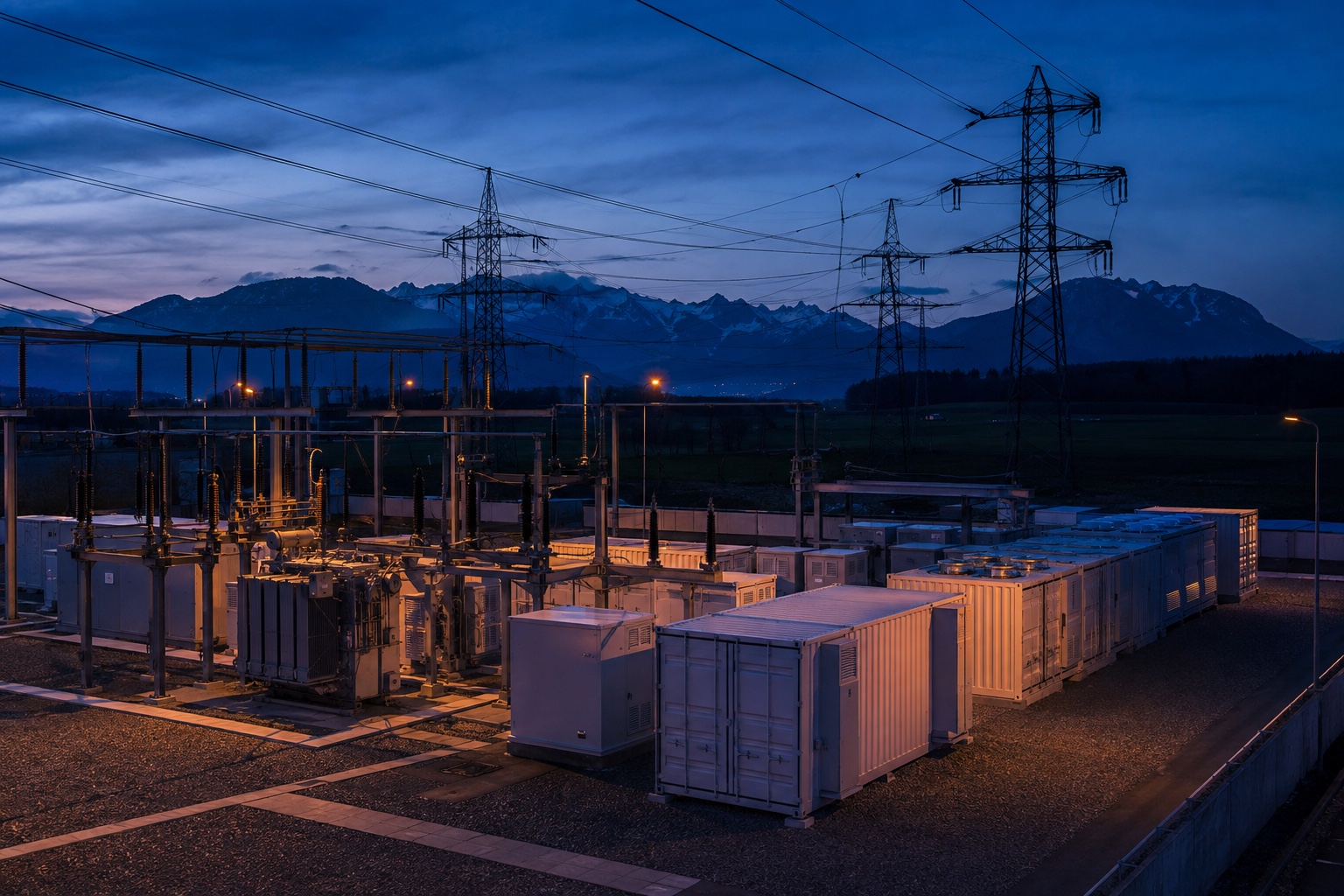
A BESS can change active power very quickly. That makes it relevant to frequency stability in Switzerland, but “fast” is not a complete service specification. Physical inertia, primary control, secondary control and tertiary control act on different signals and timescales. A credible project must identify which layer it can deliver, how it is prequalified and what operating headroom remains available.
Swissgrid states the operating principle plainly: electricity generation and consumption must remain balanced so that system frequency stays at 50 Hertz. Forecast errors, an unplanned plant outage or a change in demand can disturb that balance; control energy is then used to contain and restore frequency.[1, 8]
Battery inverters can alter active-power output rapidly and can move in both directions if state of charge and connection capacity permit. But the system does not buy “speed” as one generic product. Swissgrid distinguishes primary, secondary and tertiary control, each with its own activation logic, response time, bid structure and prequalification requirements.[2, 5]
This distinction is also a due-diligence test. A statement that a battery “supports frequency” is incomplete until the project identifies the product, qualified power, energy reserve, metering, control interface and duration of delivery.
Milliseconds, seconds and minutes are not interchangeable. The first check is to match the claimed BESS response to the mechanism that Swissgrid actually specifies.
| Response window | Mechanism | What must be true |
|---|---|---|
| First milliseconds | Physical or synthetic inertia | Rotating machines supply physical inertia automatically. Converter-based resources do not. For storage connected at transmission grid level 1, Swissgrid now requires grid-forming capability and synthetic-inertia response to begin within a maximum of 10 ms after a frequency disturbance.[2, 3] |
| Within 30 seconds | Primary control / FCR | The unit reacts to measured frequency without a dispatch signal and reaches 100% of prequalified power within 30 seconds. Swissgrid's 2026 roadmap lists bids from 1 to 25 MW.[2] |
| Within 5 minutes | Secondary control / aFRR | Swissgrid sends a signal every second; the provider reaches 100% of prequalified power within five minutes. The published current volume is 5 to 100 MW, with smaller bids shown as a possible later change.[2] |
| Within 10 minutes | Tertiary control / mFRR | Swissgrid's roadmap specifies full activated power within ten minutes. Product and minimum-volume changes are staged, so the applicable rules must be checked at the tender date.[2] |
The table is a sequence, not a ranking. Fast containment limits the initial movement; restoration products bring the system back towards its target and release earlier reserves for the next event.
Traditional generators with rotating mass — including hydropower and nuclear plants — contribute physical system inertia as a by-product of synchronous operation. Swissgrid's Balancing Roadmap notes that PV and battery systems connect through converters and do not automatically provide the same effect.[2]
Swissgrid's technical minimum requirements for converter-based storage connected directly to transmission grid level 1 therefore require grid-forming controls. The document calls for virtually delay-free frequency and voltage support, and requires synthetic inertia to start within 10 ms after a frequency disturbance. It also says the control must remain coordinated with converter current limits and other control functions.[3]
That scope matters. These are connection requirements for covered transmission-connected systems, not evidence that every distribution-connected BESS in Switzerland is grid-forming or supplies synthetic inertia. Nor does the document create a current Swiss market product for inertia: Swissgrid says a dedicated Fast Frequency Response or inertia product is unlikely to be required in the next few years, while retaining the option to introduce one if needed.[2, 3]
The 20 MW / 18 MWh battery at Ingenbohl in the canton of Schwyz was prequalified by Swissgrid for secondary control power on 24 September 2020. Alpiq's published account highlights the practical issue behind that status: the battery and its control software must interact so that the unit follows communication signals correctly and quickly enough.[6]
A separate Swissgrid–ewz pilot, completed in December 2022, tested a distribution-connected battery using a rule-based coordination approach. The objective was to let decentralised resources support transmission- and distribution-system needs while accounting for effects on neighbouring and upstream grids. It demonstrated a coordination mechanism in a pilot; it did not establish a generally available dual-use product.[7]
Those examples are more informative than a generic claim about battery speed. One shows actual prequalification for a defined reserve product; the other shows why distribution constraints and TSO–DSO coordination can limit or condition dispatch.
Swissgrid kept system frequency stable in 2024 but recorded a significant rise in frequency deviations, mainly because solar production had become harder to forecast. The consequence was greater use of control energy.[4]
The following year also supplied a useful counterpoint. Comparing the first ten months of 2025 with the same period in 2024, Swissgrid reported a 22% reduction in activated secondary control energy, partly attributed to an AI-supported solution for control-energy requests. Storage hydropower remained the largest supplier, while batteries and other technologies were expected to take a larger role.[1]
This is why frequency resilience should not be reduced to installing more capacity. Forecast quality, reserve dimensioning, market access, control design and grid coordination all change how much control energy the system needs and which assets can supply it.
A battery can be part of the response. It does not remove the need for accurate schedules, sufficient inertia, transmission capacity or well-designed reserve procurement.
The purpose is to connect a system-level service to the equipment, contracts and operating constraints of one battery project.
FCR, aFRR, mFRR, voltage support or another service — not “grid services” as an undifferentiated category.
The MW that passed the relevant technical and operational appraisal, rather than only the inverter nameplate.
The state-of-charge range reserved for upward and downward response across the required delivery period.
Signal latency, EMS logic, metering, telemetry and the tested interaction between software and power-conversion equipment.
Connection limits and DSO conditions that may restrict a dispatch even when the TSO requests it.
How control energy, local congestion management, industrial-site needs and maintenance windows are prioritised.
Frequency control, voltage support, black start and island operation are listed by Swissgrid as separate ancillary services. A battery that is prequalified for a reserve product is not thereby proven to energise a dead network, form an island or supply an industrial facility through an outage.[5]
That boundary is important for both engineering and communication. “Grid resilience” is a broad outcome. The credible claim is narrower: this BESS can deliver a defined response, at a tested power level, through a specified control chain, for a stated duration and within its connection conditions.
The technical, product and operating-status claims above were checked against these public sources on 7 September 2026. Product rules can change; quotations are kept short.
Electricity generation and consumption must be permanently balanced in the grid so that the frequency remains stable at 50 Hertz.
Primary, secondary and tertiary control stabilise or restore frequency within seconds or minutes.
The provision of synthetic inertia must begin within a maximum of 10 ms after a frequency disturbance.
A significant rise was nonetheless recorded in frequency deviations.
This is the basis for the participation of providers in ancillary service tenders.
The battery prequalified for the provision of secondary control power on 24 September 2020.
The concept and its implementation were tested with a battery connected to the distribution grid of ewz.