
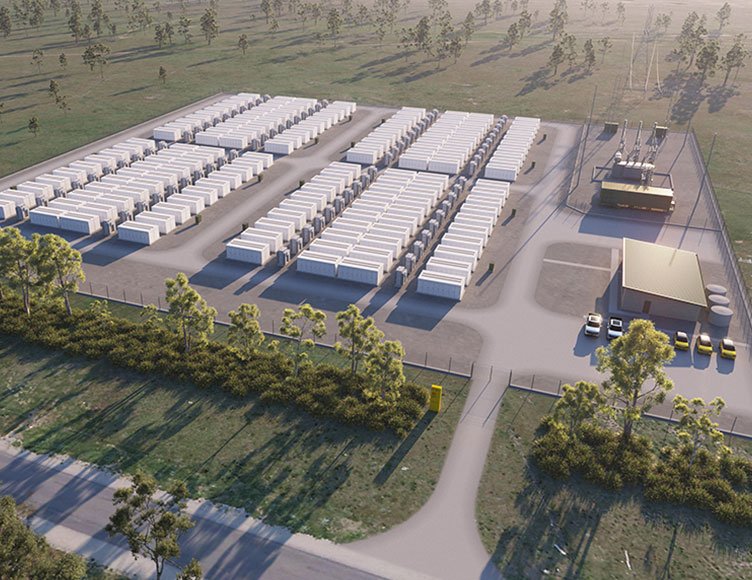
The default way to build battery storage in Europe has been to find a willing grid node and serve the balancing markets. Those markets are small, and every new battery makes them smaller for everyone. A battery behind the meter of an industrial site rests on a structurally different footing — here is why the distinction matters, especially in Switzerland.
A standalone battery at a grid node sells system services: frequency reserves, balancing energy, wholesale flexibility. These are real, necessary services — grids need them more as renewable generation grows. But they share one property that gets little attention while a market is young: the demand for them is fixed by the system operator, not by the number of batteries built. The grid needs a certain quantity of frequency reserve. It does not need more of it because more batteries exist.
That makes the standalone model a shared-pool business. Every battery that prequalifies for the same reserve product bids into the same finite tender against every other battery. While batteries are scarce, the pool pays well. As they multiply, the pool does not grow with them — the competition does. This is not a prediction; it is arithmetic, and it has already played out in the markets that industrialised battery storage first.
A battery at a grid node competes with every other battery for the same fixed pool of system services. A battery behind the meter of an industrial site also performs a job that belongs to that site alone — and no amount of fleet growth elsewhere takes it away.
Great Britain was the first European market where battery buildout overtook frequency-service demand, and the analytics firm Modo Energy documented what followed: once available battery capacity exceeded roughly one and a half times the procured service volume, capacity prices in those services compressed by roughly three quarters within a year. Germany is now approaching the same threshold — around 4.5 GW of battery-relevant reserve capacity is procured there, and Modo estimates that if the German fleet reaches 5.7 GW by end-2026, batteries alone could cover the entire 2 GW aFRR requirement with only about a third of the fleet prequalified.
| Market | Procured reserve demand | What the numbers imply |
|---|---|---|
| Great Britain | Frequency services overtaken by fleet growth | Above ~1.5x overbuild, service prices compressed by roughly three quarters within a year |
| Germany | ~4.5 GW battery-relevant, of which ~2 GW aFRR | A 5.7 GW fleet with ~35% prequalified would cover the entire aFRR capacity requirement alone |
| Switzerland | ~80 MW FCR (2026); aFRR/mFRR bid sizes 5–100 MW | A single mid-sized project materially changes the competitive balance of the national reserve pool |
Sources: Modo Energy — German ancillary-service saturation and the GB precedent · Swissgrid — Balancing Roadmap Schweiz 2026–2030 (PDF, in German). Figures describe procured market volumes and fleet capacities as reported by the cited sources; they are market-structure observations, not projections for any specific project.
The Swiss number deserves a pause. Switzerland's entire primary frequency reserve requirement is about 80 MW — allocated to it under the European dimensioning process, per Swissgrid's own roadmap. For comparison, a single large Swiss battery project under construction today can exceed 100 MW. The national reserve pool that a standalone strategy leans on is smaller than individual projects being built to serve it.
None of this makes system services unattractive — Swissgrid is actively widening access, cutting minimum bid sizes to 1 MW through 2026–27 and building new flexibility products. It makes them what they are: a competitive, finite pool that rewards early movers and compresses as the fleet grows. The question for anyone siting a battery is what the asset stands on when that happens.
Move the same battery behind the meter of an energy-intensive site and its primary job changes character. Cutting a factory's peak demand, raising the self-consumption of an on-site PV installation, keeping a site inside its connection limit — these are services performed for one specific host, under contract, against that host's own load profile. They are not auctioned against the national fleet. When the tenth or the hundredth battery connects somewhere else in the country, the December peak of this factory still needs shaving, and only the battery standing behind this meter can do it.
The system-service pool doesn't disappear from the picture — it changes role. In the hours when the site's own needs leave headroom, the same asset can still offer flexibility outward through the existing connection. The site-specific job is the part of the case that fleet growth cannot erode; the shared pool becomes the variable layer on top, taken when available rather than depended on. Structurally, that is a different risk shape from an asset whose entire purpose is the pool.
There is a second, distinctly Swiss reason this siting logic matters: the connection itself. As we examined in our analysis of Swiss BESS development feasibility, connection capacity is the binding constraint in this market — surveyed distribution operators report request queues exceeding 10% of network load, waiting lists and capped agreements. An industrial site with an existing medium-voltage connection and unused headroom already holds the scarcest asset in the whole development chain. Building behind that meter does not join the queue; it uses capacity that is already secured and often underused outside production peaks.
The industry argues in shorthand — two-hour versus four-hour systems — as if duration were a matter of conviction. Behind the meter, it is not. The right duration falls out of the host's load physics: how long the peaks last, how they cluster, and what the binding constraint of the year looks like. In our industrial BESS + PV case study, a full year of quarter-hour meter data showed the sizing answer was set by one December cluster of back-to-back peak hours — a property of that site's operations that no market-level rule of thumb could have produced.
The general point survives beyond any single site: longer duration widens what a battery can do — broader peak coverage, more load shifted, more headroom left over for outward flexibility — and several European capacity mechanisms now explicitly reward sustained delivery over instantaneous power. But the starting point is the constraint the battery exists to solve. A duration chosen from a market fashion, in either direction, is a sizing error with a long life.
The siting question reads differently depending on what you hold — but it points the same way.
A meaningful electricity bill, recurring peaks and an existing connection make a site the natural home for storage — the job is on-site, and the scarcest input is already in hand. Industrial sites
Proximity still rules — but proximity to load and grid together beats bare grid proximity. Land adjoining industrial zones carries a siting logic that pure node plays lack. Land for battery storage
In a market whose reserve pool is measured in tens of megawatts, projects anchored to a site-specific job are the ones built on ground that doesn't move. Developers & partners